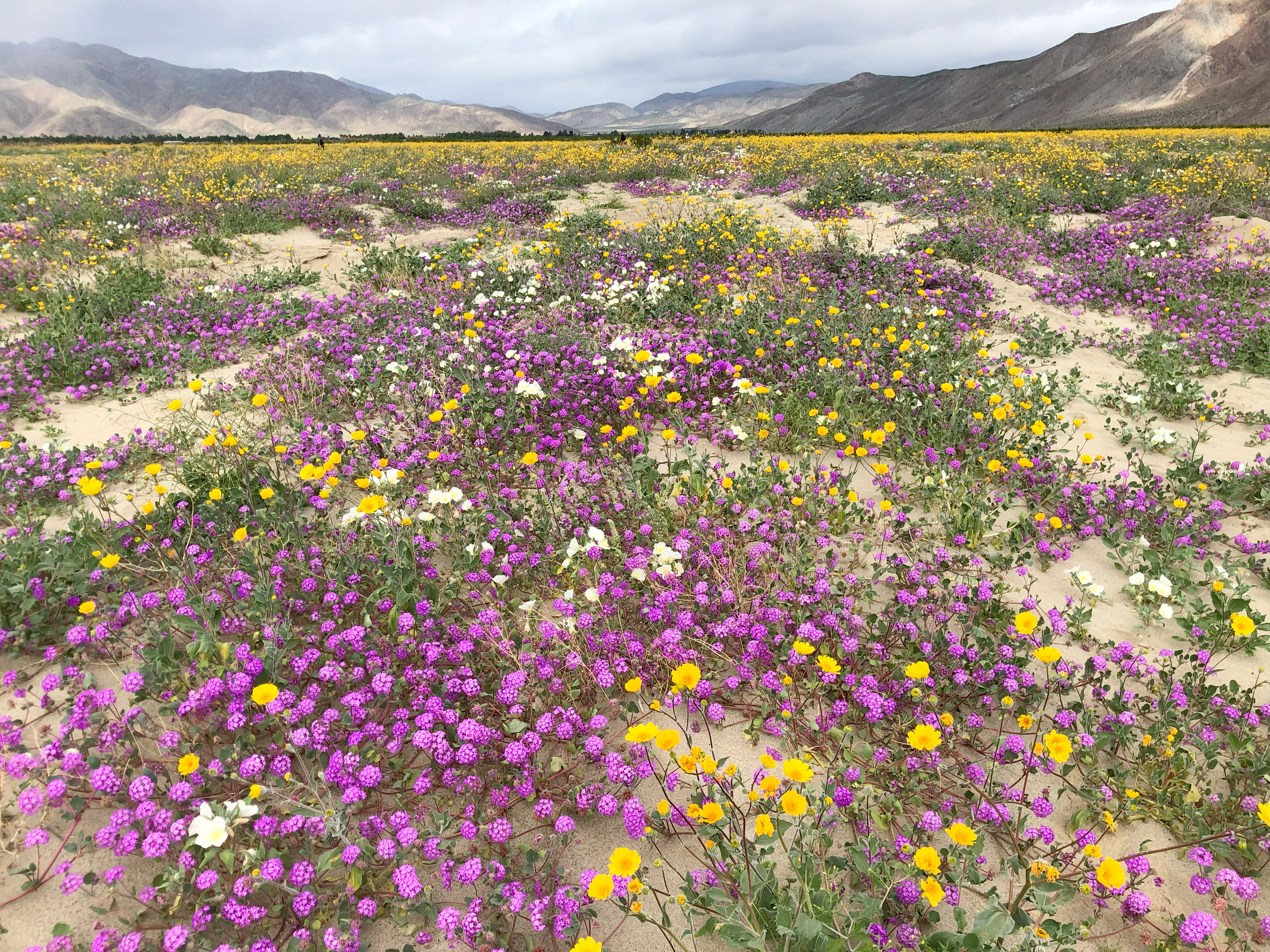
I spent some time in Anza-Borrego State Park in Southern California in March. Although reports say the California deserts are not going through a superbloom this year, I think this display along Henderson Valley Road would qualify. The rest of the park was nowhere near as spectacular as this.
Wednesday, April 3, 2024
Monday, January 22, 2024
Winter in the Mojave
I spent an enjoyable couple of weeks out in the Mojave Desert over the holidays, doing research for a potential next book. The weather was fairly overcast for most of the trip, but clouds did clear for a beautiful view from my campsite near the Marble Mountains on New Year’s Eve. Here’s a view of the night sky from that campsite, with the constellation Orion at the upper left. Orion’s belt is aligned vertically and his dagger is pointing off to the right. The fuzzy star in his dagger is actually the Orion nebula. Although I was camped out in a remote spot, in the Mojave you’re never far from some sort of human presence. The orange glow along the horizon is from the headlight of a distant BNSF freight train headed west toward Barstow.
About an hour’s drive from Amboy is another notable spot, the Iron Mountain Camp. In World War II, this was one of the camps in the Mojave Desert the Army used to train troops in desert warfare before they were sent to North Africa to battle Rommel’s Afrika Korps. Although commonly associated with General George Patton, who created it in early 1942, he was there for only a couple of months before heading off to Washington to plan the US invasion of Morocco. The camp remained open until early 1944. If you are familiar with the Humphrey Bogart movie, “Casablanca” you should know the movie got its name because after Patton’s army landed in Morocco at Casablanca, the town’s name was all over the news.
The Iron Mountain Camp still retains the layout of its rock-lined dirt roads, although all the structures have long since been removed except for the stone chapel. It only consisted of a single wall, with troops seated outside for services. The Bureau of Land Management has fenced off the entire camp to prevent access by off-road vehicles, but turnstiles in several locations allow foot traffic to enter. The camp is a relic of a different time, and it’s remote location virtually assures you will be the only one there.
Wednesday, August 23, 2023
Good News about Utah Monuments
I was happy to hear that on August 11, Federal District Court Judge David Nuffer granted a motion to dismiss lawsuits filed by the State of Utah and Garfield and Kane Counties challenging President Biden's restoration of the boundaries of Grand Staircase-Escalante and Bears Ears National Monuments. Judge Nuffer wrote, "In spite of the sincere and deeply held view of the Plaintiffs, there is no relief for them in this action. It has long been held that where Congress has authorized a public officer to take some specified legislative action when in his judgment that action is necessary or appropriate to carry out the policy of Congress, the judgment of the officer as to the existence of the facts calling for that action is not subject to review. President Biden’s judgment in drafting and issuing the Proclamations as he sees fit is not an action reviewable by a district court.
Steve Bloch, Legal Director of the Southern Utah Wilderness Alliance, was quoted by the Associated Press as saying, “Grand Staircase-Escalante and Bears Ears National Monuments are two of the most significant, intact, and extraordinary public landscapes in America—landscapes that will remain protected after today’s dismissal of these lawsuits. We are thrilled with today’s decision, which aligns with more than one hundred years of similar court rulings that have rejected every challenge to Presidential authority under the Antiquities Act to protect cultural, scientific, ecological, and paleontological resources on public lands.” Of course the battle is unlikely to stop there. The plaintiffs have already begun the process of filing an appeal, but Judge Nuffer's decision is very good news.
Saturday, August 12, 2023
Sad News
In my book, The Slickrock Desert: Journeys of Discovery in an Endangered American Wilderness, I share stories of several adventures I was joined on by my wife, Nicki. Although camping was never at the top of her list of things to do, she was always a sport in coming along with me. I'm sorry to say that Nicki passed away in June after an extended bout with cancer. She spent the last couple of months in home hospice, with a hospital bed in our family room. My daughter, Juliana, and I were with her when she passed. Fortunately she was never in any pain, she just kept getting more tired until she finally passed. It's taken awhile for me to get used to my new life, but I'm back to keeping busy now. Although Nicki is now gone, she will never be forgotten.
Wednesday, April 12, 2023
"Slickrock Desert" book to receive national award
I'm honored to announce that my book, The Slickrock Desert, has been named a finalist in the prestigious 35th Annual IBPA Benjamin Franklin Awards™ competition, sponsored by The Independent Book Publishers Association (IBPA). As one of three finalists in the category of Regional nonfiction, I will receive either a gold or silver medal award during a special dinner ceremony on May 5 in San Diego, California. See IBPA’s announcement here: www.ibpabenjaminfranklinaward.com/winners-regional.
Friday, June 24, 2022
Progress on Bears Ears National Monument
Important news was announced this week that will build on the future of Bears Ears National Monument. The BLM and Forest Service have signed an Inter-Governmental Cooperative Agreement with the five Tribes of the Bears Ears Commission to establish a cooperative arrangement to manage the monument. It is the first time the government has established a formal process for working with Native American Tribes to manage public lands.
Established in 2016 by Presidential Proclamation from President Barack Obama, the monument was the result of lobbying by Native American Tribes and the environmental community as a way to protect a threatened region of important cultural heritage and paleontological resources. A year later, Donald Trump unilaterally downsized it by 85 percent even without legal authority to do so. President Joe Biden restored the full extent of the monument (including acreage not included in the original proclamation but added by Trump) in 2021.
Carleton Bowekaty, Lieutenant Governor of Zuni Pueblo, stated, "Today, instead of being removed from a landscape to make way for a public park, we are being invited back to our ancestral homelands to help repair them. Mark Maryboy of the Utah Dine Bikeyah greeted representatives of the five Tribes as they came together in Bears Ears with a simple message: "Welcome home."
You can read more about this historic agreement here.
Thursday, June 2, 2022
Alternative Theory of Pictograph Panels
I received an interesting email today from Wayne Raymond, one of the people who reviewed an early draft of my manuscript for The Slickrock Desert. Wayne provided excellent feedback that helped make it a better book. He was particularly interested in my stories about pictographs and petroglyphs, including a photo I had taken of a series of figures of what are known as the Barrier Canyon style of pictographs on a wall in Sego Canyon.
In my book, I had referred to Polly Schaafsma, an expert on these figures who believes them to be as much as three thousand years old. I had mentioned that while the meaning of these pictographs is subject to debate, archaeologists generally think the figures with large heads and empty eye sockets may represent the dead, and that they have no arms or legs because they are wrapped in funeral blankets.
Wayne sent me a link to a Twitter thread here whose author refers to that same pictograph panel and offers a different explanation. He believes the figures with the horns draw from bighorn sheep, who are most sexually active during the summer monsoon season, with males banging their heads against each other to prove their prowess. This is also the time when adequate rainfall is critical to the success of the harvest, and the author believes that the relationship between rutting bighorn sheep and summer rains is woven into the figure's headdress. He goes on to show how the elongated shapes could represent downpours called microbursts common during the summer monsoons. The figures would then represent not death but the hope for a bountiful harvest. It's an interesting theory well worth considering, although it would seem to be a bit of a stretch. But who knows, it could be accurate. In any event, here's my photo of the pictographs in question.
Wednesday, May 25, 2022
Journeys of Discovery in an Enchanted Land
I'm happy to say my new book, The Slickrock Desert: Journeys of Discovery in an Endangered American Wilderness, is hot off the presses. Besides the usual distribution channels (Amazon, Ingram, etc.), I'm excited to announce that Atenera Press (www.atenera.com) has signed a distribution agreement with Mountain Press of Missoula, Montana, a respected publisher of outdoor-related books for over 70 years. You may recognize them as the publisher of the series of Roadside Geology books covering numerous states. My book is also available in a number of retail bookstores, including Bright Side Bookshop in Flagstaff, Arizona and The King's English Bookshop in Salt Lake City. I encourage you to support any of these retailers, and if your local bookstore doesn't carry it, ask them to do so.
As I say in the book, reading about the desert is one thing, but to really get a feel for it, you need to get out and pay it a visit. If summertime in southern Utah isn't your thing, start planning a visit for October, my favorite month in the desert. Summer crowds are long gone, spring crowds won't be there for months. The days are comfortably warm, and the snows of winter have not yet arrived. It's a time of golden yellow cottonwoods and coral-colored cliffs blazoned against azure blue skies--the perfect time to explore a rugged land like no other on earth. Get out and enjoy it!
Monday, January 31, 2022
Slickrock Desert book nearly ready
After two years of serious writing, my new book, The Slickrock Desert: Journeys of Discovery in an Endangered American Wilderness, is in final production. It uses stories of my own explorations of the canyons and mesas of the Four Corners region of the American Southwest to introduce the reader to its history, natural history, geology, ecology, and what we know of its earliest inhabitants. I've already received welcome testimonials from such notable people as the author Stephen Trimble, whose works include The Capitol Reef Reader and Redrock Stories, and Carolyn Z. Shelton, Assistant Monument Manager (retired) of Grand Staircase-Escalante National Monument. Both Stephen and Carolyn read my entire manuscript and gave me welcome feedback on how to make it the best book possible.
I just received printed copies of what is called an "Advance Reader Copy." The "ARC" is very close to the final book but usually needs a little more editing before publication. ARCs go to book reviewers so they have time to review the book and write about it in advance of publication. The publication date for The Slickrock Desert is March 15, and everything is on track for that date. I only needed to edit a few lines of text, adjust a few margins, and optimize some of the photos for best reproduction quality. The final files are off to the printer now, with the first print run to be completed in a couple of weeks. Another couple of weeks to get those copies into distribution and it will be ready to go. Here's what the ARC looks like. The final book will be nearly identical. To learn more, take a look at the Atenera Press website at www.atenera.com.
Monday, January 24, 2022
State of Utah to Challenge Biden's Restoration of Bears Ears and Grand Staircase
The State of Utah has decided to move forward with a challenge to President Biden's restoration of Bears Ears and Grand Staircase Escalante National Monuments. They have hired a law firm (at $498/hour) to research potential litigation based on recent opinions from some members of the U.S. Supreme Court that the Antiquities Act is the wrong way to protect large landscapes in southern Utah. This action came several days after about one hundred members of a coalition of Hopi, Navajo, Utes, Ute Mountain Utes, and Zuni marched on the Utah State Capitol to protest the potential lawsuit. Southern Utah Wilderness Alliance has set up a website for you to share your thoughts with Utah Governor Cox. You can access the site HERE.
Tuesday, November 2, 2021
President Biden Restores Bears Ears and Grand Staircase-Escalante
It took nearly nine months, but President Biden restored the original boundaries of Bears Ears and Grand Staircase-Escalante National Monuments on October 8. Bears Ears now also includes 11,200 additional acres not part of the original proclamation but somewhat surprisingly added by Trump (I guess as sort of a "consolation prize") when he sliced its boundaries 85% in 2017. Biden's proclamation was great, although I might have preferred the lawsuits against Trump's actions to be resolved (assuming the courts decided against Trump) so the same kind of thing couldn't happen with future presidents. Of course there was always the possibility the courts could side with Trump, so perhaps it's better this way. If any future president tries to do a similar hatchet job, we will just have to deal with it then.
You can read the Press Release from the U.S. Department of Interior HERE.
Tuesday, January 19, 2021
Hope for Bears Ears and Grand Staircase-Escalante
With President-Elect Biden's inauguration imminent, there's hope he will restore the two national monuments that Trump drastically reduced back to at least their original boundaries. It's one of his campaign promises and appears to be on his initial list of action items. Even many Utah officials want it to happen. Both the Grand County Commission and the San Juan County Commision have sent letters to Biden requesting that the Bears Ears original boundaries be restored. The town councils in Moab and Bluff sent similar letters. Being that this is Utah, though, not everyone is in favor. The towns of Blanding and Monticello have both objected to restoration of the original boundaries, claiming they were set without sufficient local input.
Soon after Trump's proclamation, numerous organizations and all five of the region's Native American Tribes filed lawsuits claiming the Antiquities Act did not give him the legal power to shrink the size of the monuments. The lawsuits are still languishing in the courts. Ideally, the courts would rule in favor of the plaintiffs, as this would establish a precedent against any similar actions a future president might consider, but the lawsuits will probably be dismissed as moot once Biden takes action. And since there is always a possibility the courts could rule in favor of Trump, it's probably best to let them be dismissed and fight again if the issue arises again in the future.
I've hiked much of the disputed area and agree it is important to be protected. Here's one example of an Ancestral Puebloan ruin that was within the original boundary of Bears Ears but excluded after Trump's proclamation:
Monday, December 14, 2020
A Surprise Graduate Degree
It’s not every day you find out a bona fide university long ago awarded you a graduate degree you never knew about. Not some honorary degree but a legitimate Master of Arts degree in engineering. Well, I just discovered it happened to me. And before you start questioning its authenticity, let me assure you it is indeed valid. Here’s the story. I did my undergraduate work at Harvey Mudd College in Claremont, California (it’s a good school, traditionally ranked #1 or #2 in undergraduate engineering programs by US News and World Report). I could have just gone for a B.S. degree in engineering, but the school offered another option. Stay on for a fifth year and earn a Master of Engineering degree. It sounded attractive, so at the beginning of my junior year, I applied and was accepted. The only catch was that Harvey Mudd was only accredited to be an undergraduate institution; they couldn’t award graduate degrees. So, in some arcane way, they teamed up with Claremont Graduate University across the street to award the degree. The story I was told was that at graduation after my fifth year, Harvey Mudd would award my Master of Engineering degree first, then follow with my bachelor’s degree. That way the ME degree would qualify as my first degree, which would allow them to retain their undergraduate accreditation. And that’s what happened. At the graduation ceremony, I received a nice diploma stating that Harvey Mudd College was conferring on me a Master of Engineering degree. Hidden away underneath it in the same presentation folder was the diploma for my B.S. degree in engineering. I never really understood what role Claremont Graduate University played in all this until I recently received a letter from their alumni association. They were asking for a donation because I was a CGU graduate with a Master of Arts degree in Engineering. Having never heard this before, I contacted their alumni association and was assured that, yes indeed, I have an MA degree in engineering from their university. At this point in my career it’s too late to have any impact on my resume, but it’s a nice little surprise—two master’s degrees for the price of one! And by the way, Harvey Mudd ended their M.E. program some years later because of the complexity in administering it. The only downside is that I now have one more school I should give donations to every year.